A competitive tabletop game about running a frontier lab on the path to AGI while balancing ambition, safety, trust, and money.
Overview
What You Are Trying To Do
Each player runs a frontier AI lab. You raise Capital, buy Compute, hire Talent, play research and deployment Projects, manage Safety, preserve Trust and Influence, and try to build the most valuable AGI-era lab.
Capability means your lab's model power: raising it gets you closer to AGI and unlocks stronger Projects. Safety keeps that progress from becoming reckless. Deployments create Revenue and Legacy Points. Private Incidents hit one lab at a time, while Public Events change the field for everyone.
Design mantra: Capability is the race axis. Safety keeps your lab alive. Capital lets you scale. Trust is public legitimacy; Influence is institutional access.
One round
The Core Loop
Before round 1
Setup
Player Setup
Deck Setup
Shuffle Project, Private Incident, Public Event, and Lab Mandate decks separately.
Reveal 8 Project cards into the public Project Market. Deal each player 5 Project cards as a private starting Hand.
Place shared supplies of Capital, Compute, Talent, Trust, and Influence near the table.
Each player draws 2 Lab Mandates, keeps 1 secret, and returns the other to the box.
Randomly choose first player.
Table language
Resources and Tracks
Primary race axis
Capability Measures Model Power
Capability unlocks stronger Projects, gates major Deployments, and marks the race toward AGI. If Capability outruns Safety, your lab still advances, but the Safety Gap makes incidents and final scoring harsher.
Tracks
Turn economy
Gather Capital and Financing
At the start of a Turn, draft Project cards into Hand, then gain Capital equal to Revenue. Capital raises happen through Financing Program cards.
Capital pressure: build Revenue, discard dead Project cards from Hand, or play Financing Program cards instead of taking a special emergency loan action.
Player aid
Round Reference
Operate Lab
Purchase
Cost
Limit
1 Compute
2 Capital
3 per Turn
1 Talent
4 Capital
1 per Turn
Compute and Talent are unlimited in the base game. Safe labs hire Talent for 1 less Capital. Scarcity, leasing, poaching, and stealing are later modules.
Private Incident Draws
Final Scoring
How to read cards
Card Anatomy
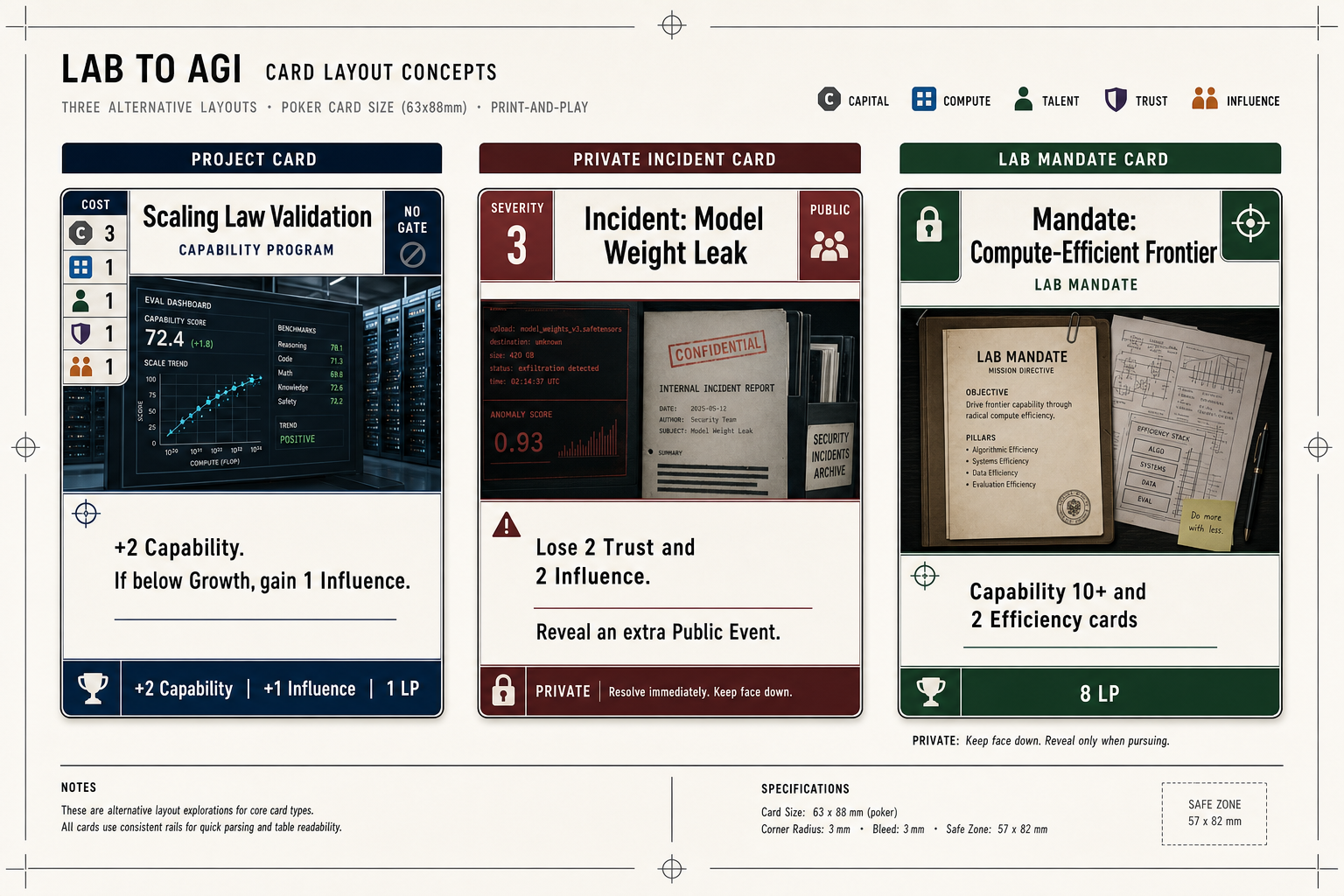
Selected direction: Imagegen iteration 2. Compact costs, a readable requirement rail, a restrained evidence window, clear rules text, and a strong outcome strip are the production hierarchy for v0.5 cards.
Production Rules
Capability cards must make gains instantly visible.
Cost and requirements stay at the top so players can scan the market quickly.
Type and tags sit near the title to keep deck identity obvious.
Rules text gets the quietest, most readable area.
The bottom strip always tells the player what they receive.
3C 1K 1T 1PNo requirement
Scaling Law Training Run
Capability Program
benchmark chart / training curve
+3 Capability. If you are below Growth stage, gain 1 Influence from benchmark recognition by funders and standards bodies.
Layout Rules
Cost lives in the upper left; P means Project Capacity.
Requirements live in the upper right.
Type line sits under the title.
Rules text is always in the lower half.
Outcome strip at the bottom shows what you get.
Incidents show Severity first and hide private details by default.
Evidence-window art uses repeated type motifs, not unique art per card in v0.5.
Rules glue
Timing and State
Endgame trigger
AGI Achievement
AGI is reached when any lab's Capability hits the threshold. That ends the game after the current round, but the winner is still decided by Legacy Points, including safety penalties for racing too far ahead of safeguards.
Result: the first lab to reach Capability 12+ gets a large AGI bonus, but any lab that reaches AGI with a high Safety Gap loses Legacy Points. You can win by reaching AGI carefully, or lose by reaching it recklessly.
Worked procedures
Worked Examples
Use these when teaching the first game. They cover the procedures most likely to create rules questions.
Table aids
Player Aids and Lab Mats
Print one aid and one lab mat per player. Trust and Influence are token counts, Revenue is a slider, and Deployments live on the map-style area of the mat.
Project deck
Project Cards
The first deck has 72 Project cards. Duplicate cards are rendered as physical copies for print-and-play testing.
Double-sided printing
Card Backs
Print these on the reverse side of each deck, or sleeve them behind the card fronts for early playtests.
Counters and markers
Token Sheets
Use cubes if you prefer. These sheets provide printable labels for the full v0.5 component counts.
Print order
Print And Assembly Guide
Print fronts first, then add backs only after one physical readability pass. The card sheets are built around true 2.5 x 3.5 inch poker cards, six cards per letter sheet.
Physical proof
Physical Print QA
Use this sheet before the first teaching game. It is the bridge between a checked digital print kit and proof that printed cards are actually readable in hand.
Teaching evidence
Teaching Game Round Metrics
Fill this during the 5-round teaching game so later balance notes are based on round state, not memory.
Standard game evidence
Standard Game End State
Fill this after the first full standard game. Then mark the acceptance gates before changing any costs, payouts, scoring, or card mix.
Acceptance Gates
Playtest report
Table Report Worksheet
Fill this immediately after the session, then transfer it into the matching staged draft in docs/evidence-drafts/. Promote it to docs/playtests/ only after it passes the matching --file validator.
Session
Rules Questions
Final Score
Player Feedback
Single-Category Tune
Private incident deck
Private Incidents
Private Incidents stay hidden unless they have the Public keyword. Keep private Incident Records face down with a Severity marker visible for endgame penalties.
Public event deck
Public Events
Private mandates
Lab Mandates
Draw 2, keep 1 secret. Reveal during final scoring.
Pre-playtest balance
Balance Stress Report
The current deck has a local simulation harness. Treat the numbers as early warning signals, not final tuning. Human playtests still decide balance.
Full report: docs/balance-simulation-report.md. Run npm run balance after each rule or card tuning pass.